Hungry Tum turns underused kitchens into profitable fulfilment capacity.
Hungry Tum runs the systems around demand, menus, supply, customer channels and optimisation so existing kitchens can earn more from the space, team and equipment they already have.
Hungry TumA distributed food fulfilment network
Problem
Fixed costs keep running while capacity sits idle.
When sales do not cover rent, staff, bills and food costs, restaurants lose money every day they stay open.
The cost base
Rent and rates
Staff and management
Equipment and utilities
Food waste and margin pressure
+
The lost upside
Underused kitchen space
Spare production capacity
Too few profitable revenue channels
Limited resources to build new revenue channels alone
Business deaths
26,195
UK hospitality businesses died in 2024.
Insolvencies
3,369
UK hospitality insolvencies in the 12 months to Apr 2025.
Failure concern
1 in 5
Hospitality businesses feared failure within 12 months in a 2026 survey.
Food waste cost
£3.2B
Annual UK hospitality and foodservice food-waste cost.
Sources: ONS Business demography 2024; UK Insolvency Service April 2025; CGA by NIQ / UKHospitality reporting; WRAP Guardians of Grub.
Solution
Hungry Tum runs the network. Kitchens provide the capacity.
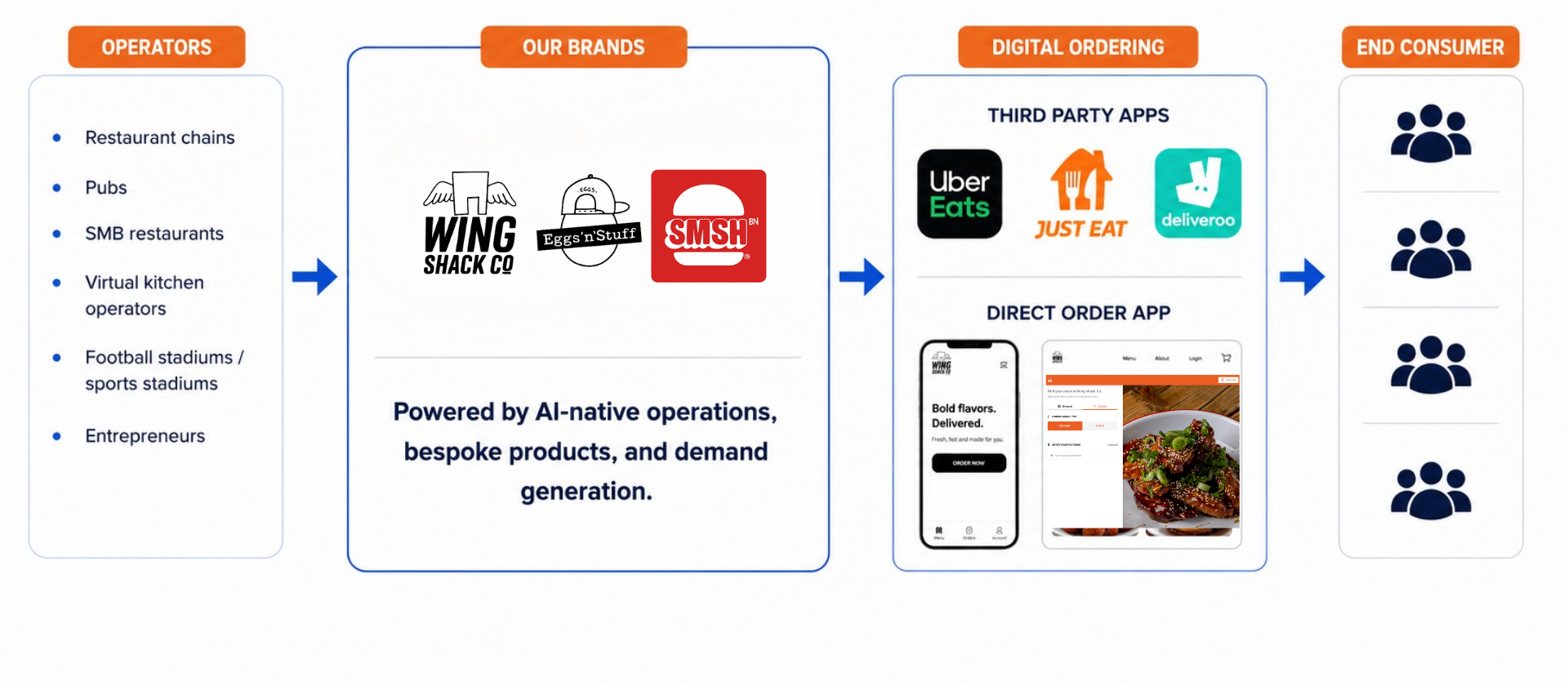
Operators and kitchens plug into the Hungry Tum network — menus and IP, demand, supply, pricing, customer channels and operating intelligence — then cook, pack and hand over. Hungry Tum manages everything around production.
How It Works
From qualified kitchen to live fulfilment node.
A kitchen qualifies, goes live as a Hungry Tum node, receives demand and fulfils orders — earning from capacity it already has.
Step 1
Kitchen qualifiesWe check capacity, equipment, compliance and location fit.
Step 2
Node goes liveMenus, stock, pricing, systems and training are activated.
Step 3
Orders flowDemand comes through marketplaces, direct ordering and local campaigns.
Step 4
Kitchen fulfilsThe kitchen cooks, packs and hands over. Hungry Tum manages the operating layer around it.
Hungry Tum manages demand, supply, economics, customer channels and optimisation after go-live.
Proof
£2.19M GMV generated since 2024.
Hungry Tum brands have traded across 50+ partner locations historically. Today 35 GFV legacy partner locations remain active, and Hungry Tum's own controlled network runs 5 active kitchens, with an active sales pipeline behind them.
Brand GMV generated
£2.19M
Across Hungry Tum brand channels, 2024-now.
Customer orders
71,320
Excludes Emirates product quantity.
Gross profit / commission
£260k
Owned-site gross profit plus network profit and commission.
Live networks
35 + 5
35 GFV legacy partner locations trading (to 9 Aug 2026) plus 5 active Hungry Tum-network kitchens.
Includes total GMV generated by Hungry Tum brands across partner kitchen networks, the Hungry Tum kitchen network and the Emirates Stadium licence with Delaware North.
Product: TUM OS
TUM is the operating intelligence behind every kitchen.
TUM holds an expected state for every kitchen, observes reality, compares the two, acts on the error, then learns.
If stock runs lowTUM reorders, recommends a basket or alerts the kitchen.
If ratings slipTUM creates a quality assurance task or human review.
If performance is strongTUM rewards the kitchen and reuses the pattern.
Live surfaces available for demo
Control RoomSupply StoreKitchen AcademyKitchen PortalCreator Kitchen
Why Now
The timing is opening the market.
Restaurants need more revenue, delivery-first demand is normal, and AI now lets a lean team support a distributed kitchen network.
Demand behaviour
Consumers are already trained to order food through delivery and direct digital channels.
Operator pressure
Restaurants need more revenue from the same fixed-cost base.
AI-native ops
Training, performance monitoring and support can now scale with a leaner central team.
Market
150 Hungry Tum-network kitchens is a small wedge in a large operator base.
Hungry Tum does not need every restaurant to be serviceable. A small share of delivery-enabled kitchens can support the first venture-scale proof point.
Global foodserviceFoodservice market across outlet types and geographies.$4.34T
UK operator baseVAT/PAYE accommodation and food businesses.177k
UK serviceable kitchensPlanning estimate for delivery-capable kitchens with spare capacity and operating fit.25k-50k
Q4 2027 milestoneHungry Tum-network fulfilment kitchens running with demand, supply, economics and QA controls live.150
Sources: Mordor Intelligence; Grand View Research; ONS; CGA by NIQ / AlixPartners; Hungry Tum planning estimate.
Business Model
We earn contribution from the network, direct ordering and supply.
Forward revenue comes from network contribution after fulfilment, growing direct-ordering economics and supply margin — with brand/IP royalties and franchise territories as upside.
Network contributionHungry Tum retains contribution after fulfilment economics on each order.core
Direct ordering economicsHigher retained economics as direct ordering mix grows.25-40%
Supply marginPartners buy approved stock through the supply store; Hungry Tum earns margin without owning stock.3-8%
Brand / IP revenueRoyalty income from internal or external IP where applicable.royalty
Franchise / future productsTerritory rights, ecommerce, sauces, CPG and other upside.upside
Forward core is network contribution after fulfilment economics, growing direct-ordering economics and supply margin. Legacy royalty and fixed-fee contracts are historical revenue, not the forward network model. Franchise territories and ecommerce are upside.
Unit Economics
Hungry Tum Fulfilment v1 economics.
Hungry Tum pays the kitchen a flat 15% of eligible ex-VAT sales on marketplace orders, with no upfront or monthly fee, and keeps the contribution after fulfilment costs.
Kitchen payout — marketplace15%flat fee on ex-VAT sales — the same for every brand.
Kitchen payout — direct23p/£1kitchens earn more per order on direct pickup.
Partner fee£0no upfront or monthly fee; paid weekly, one week in arrears.
Where £1 of order value goes
Marketplace
Direct pickup
VAT (20%)
-16.7p
-16.7p
Food cost (20-25%)
-20-25p
-20-25p
Packaging
-1.5p
-1.5p
Marketplace / delivery fee
-30-33p
-8p
Promotions / refunds
-3p
-3p
Kitchen payout (of ex-VAT sales)
-12.5p
-23p
Hungry Tum contribution
8-16p
23-28p
Kitchen payout on marketplace orders = flat 15% of eligible ex-VAT sales (12.5p per £1 of order value). Food cost 20-25% of order value varies by brand (Wing Shack ~24-25%, Eggs n Stuff / SMSH ~20%); packaging 1.5p; marketplace / delivery fee 30-33p; promotions / refunds 3p; VAT at 20%. Direct pickup replaces the marketplace fee with an 8p processing / delivery fee and pays the kitchen more (23p), so kitchens and Hungry Tum both earn more on direct orders. Contribution is per-order, before central demand, product and overhead.
Underlying Magic
Nine years of food operating judgment is hard to copy.
Hungry Tum is built from first-hand experience launching brands, running kitchens, building menus, managing suppliers and creating demand.
01Food operating judgmentMenus, products, standards, demand and nine years of kitchen reality.
02Codified workflowsRules become launch, QA, supply and intervention playbooks.
03TUM control logicWorkflows run as closed-loop control across every kitchen.
04Reusable network capabilityEach kitchen makes the next one faster and sharper.
Competitors can copy a dashboard. They cannot copy nine years of food operating judgment turned into codified workflows and TUM control logic.
Food operating judgment -> codified workflows -> TUM control logic -> reusable network capability.
We have lived the pain.Built from restaurant and kitchen work, not outside theory.
We build the full stack.Brand, menu, creative, supply, marketing, launch and software are in-house.
We translate ops into systems.Operating rules become QA actions, supply rules and launch playbooks.
Competition
Competition owns pieces. Hungry Tum combines the system.
Others own parts of the stack. Hungry Tum combines a fulfilment network, demand, supply economics, deployable IP, quality assurance and an AI-native operating layer.
Layer
Hungry Tum
Growth Kitchen
Sessions
GFV
Owned / deployable IP
✓
~
✓
✓
Demand generation
✓
✓
✓
✓
Supply economics
✓
~
✓
~
AI-native operating layer
✓
~
~
~
Quality assurance network
✓
~
~
~
Competitor rows are directional and should be used as positioning, not exhaustive feature diligence. Founder has operated with Sessions, Growth Kitchen and Global Food Ventures through Wing Shack.
Team
Built by operator-builders who have lived the problem.
Joshua and Nigel are food operators who have spent the last three years using AI to build internal tools, databases and operating workflows themselves.
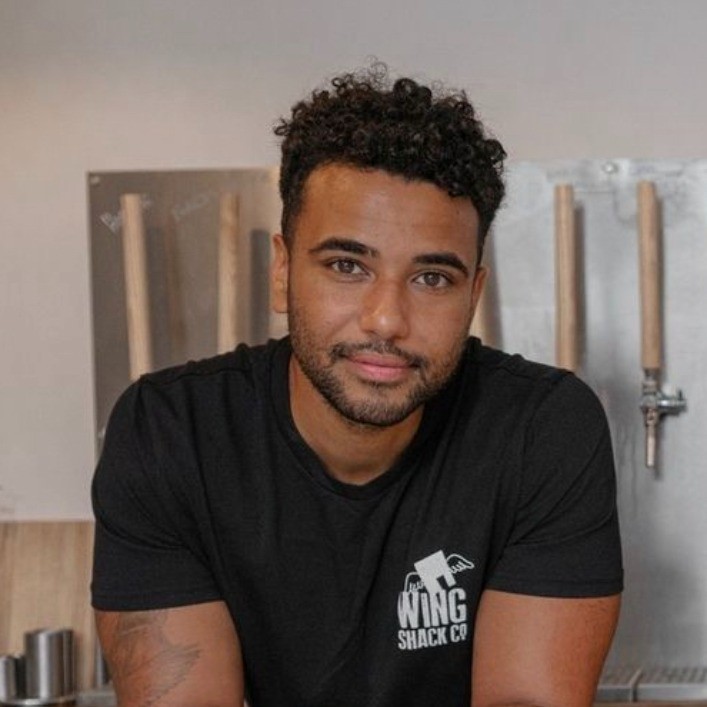
Joshua Jarvis
Co-founder / CEO
Founded Wing Shack in 2018 and scaled it across restaurants, delivery kitchens and stadium retail. Leads brand IP, product vision, TUM logic and software buildout.
Nigel
Co-founder / COO
Runs the operating backbone: kitchen network, supply chain, partner relationships and franchise rollout. Builds the supply store and internal operational tools.
2018Joshua started Wing Shack with a restaurant in Loughton.
2018-25Opened a further 7 restaurants and 10+ delivery kitchens across London.
2023Started using AI to build internal tools, databases and operating workflows.
2024-26Joshua and Nigel have operated remotely for the last two years.
Mar 2025Closed the last restaurant to go all in on AI and building the Hungry Tum platform.
Year 1Planned team: Joshua, Nigel, 2 AI engineers, Head of Brand/Marketing, Network/Ops Coordinator, Head of Food and Head Finance/CFO.
Seed Raise
£1.5M scales Hungry Tum to ~200 active UK sites.
By Q4 2027, the network targets 150 Hungry Tum-network kitchens, ~200 total active UK sites, 2.25 Hungry Tum brands per owned-network kitchen and ~£2.27M monthly GMV.
£1.5MSeed round to build the Hungry Tum network
150Hungry Tum-network kitchens
~200total active UK sites
~87korders / month
£2.27MGMV / month
£700kTeamEngineering, network operations, brand leadership, finance and founder runway.
£250kDemandPaid acquisition, creator campaigns, local launch demand and direct ordering growth.
£275kOnboarding + Quality AssuranceKitchen recruitment, launch gates, training, field support, supply and packaging stock.
£155kProduct / TUMControl room workflows, data pipelines, hosting, AI/API usage, tools and reliability.